Supervised Group Reflective Practice Still Matters—Beyond the Drift (Part 2)

Explore why supervised group reflective practice remains essential for chaplaincy formation and how education providers can sustain it in modern training. Review practical strategies and pathways to integrate reflective practice into contemporary programs.

Introduction

In Part 1, we explored the roots of supervised group reflective practice and why it remains essential for the formation of chaplains. We identified a growing tension: as academic programs expand, the embodied, communal learning that shapes competent spiritual care is slipping to the margins.

Reflective practice is costly, complex, and time-intensive. It doesn’t fit neatly into funding models or timetables. Yet without it, chaplaincy risks becoming theoretical—detached from the lived realities of suffering and hope. Formation happens in the crucible of experience and reflection—not in isolation, but in community. The question is: how do we design training that honours this truth, supports chaplains and those they care for, and meets students’ practical needs for sustained, structured, supervised reflective practice alongside ministry and workplace practicums?

Why Reflective Practice Matters

Clinical pastoral training for chaplains, pioneered by Richard Cabot and Anton Boisen, set a standard that remains relevant today. For decades, there has been broad agreement on a minimum standard for chaplaincy practicum in public institutions: a 400-hour unit of Clinical Pastoral Education (CPE) or an equivalent training program. The challenge lies in how “equivalency” is understood.


A typical 400-hour CPE unit in Australia weaves together four core components. First, Supervised Group Reflection occupies around 90 hours, usually delivered across 18 days at five hours per day, with about three-quarters of that time devoted to presenting pastoral encounters and engaging in reflective discussion. Second, students receive 10 hours of individual professional pastoral supervision, ensuring personal accountability and growth. Third, the clinical placement spans 160 hours, of which approximately 100 hours involve direct patient or client-facing care. Finally, study and assignments account for 140 hours, including the preparation of nine detailed pastoral encounter reports. These elements run concurrently, creating an integrated learning experience where theory and practice inform each other.

The critical feature of this model is that the work experience component is accompanied by sustained reflection in community—what we call Supervised Group Reflective Practice (SGRP). This is not an optional extra; it is the heart of formation.

Two Pathways Forward

To meet chaplaincy guidelines requiring a 400-hour unit of CPE or equivalent, education providers can consider two approaches. The first is to partner with an accredited CPE Centre and create a training pipeline for students. This preserves the traditional model and its proven strengths.

The second approach is to embed supervised practice within a course by designing a genuine 400-hour experiential component. This involves developing an equivalent tailored SGRP program in collaboration with a professional supervisor trained in a group supervision model—such as Value-Based Reflective Practices© developed in Scotland by chaplains. It is vital that the supervisor has experience providing professional-level chaplaincy or spiritual care. This ensures that the reflective process is grounded in real-world expertise.

Why SGRP Matters

The benefits of SGRP extend far beyond individual reflection. Trainees not only explore their own practice but also engage with 30 to 40 pastoral encounters from colleagues working in diverse settings such as mental health, aged care, defence, hospitals, and palliative care. This shared learning enriches everyone’s practice and fosters a deeper understanding of the spiritual challenges faced across different contexts. These challenges—grief, loss, suffering, trauma—are universal, reflecting what it means to be human in community.

Practical Implementation

SGRP can be delivered in various ways to suit different programs. Groups may meet in person, online, or in hybrid formats. Sessions can be scheduled weekly, fortnightly, in intensive blocks, or as retreats. An equivalent 400-hour unit can even be divided into two or three smaller units to fit semester or trimester structures. Education providers might also collaborate to create cross-institution groups, broadening the diversity of experience.

What Students Gain

Through this process, students learn to work competently with expressions of faith, religiosity, and spirituality. They internalise trauma-informed care, cross-cultural competency, and ethical frameworks, while also developing sector-specific skills such as dementia care, moral injury support, and mental health first aid. Reflective practice is structured through written reports that guide students to recall and explain encounters, apply models, explore spiritual issues, evaluate challenges, and generate insights for future practice. By the end of a 400-hour unit, students have reflected on their own eight to ten encounters and learned from thirty to forty of their peers’ experiences—a rich tapestry of learning that cannot be replicated through private reflection or theory alone.

A Closing Invitation

Cabot’s centenary is not nostalgia—it is an invitation. The spiritual needs of people have not changed. People still suffer and still search for words. Staff still carry burdens, and sustained, supervised group reflective practice is the most reliable way I know to become the kind of chaplain who can meet them.

There is this: practise, reflect, practise again—in community.

Supervised Group Reflective Practice Still Matters—A Century After Cabot (Part 1)

Why does supervised group reflective practice still matter for chaplains a century after Richard Cabot’s call for clinical training? This post explores the roots of Clinical Pastoral Training and why embodied, reflective practice remains essential in today’s chaplaincy formation.

A century ago, Dr Richard Cabot issued a plea that still resonates: chaplains need more than theory—they need a clinical year. Not just books and lectures, but bedside learning—where life is raw and questions are real. Anton Boisen called patients “living human documents.” Those words remain luminous. They remind us that formation is not abstract; it happens in the presence of suffering, in the fragile spaces where meaning frays.

When I speak of Supervised Group Reflective Practice, I mean formation groups where pastoral encounters are brought for honest reflection and feedback—where peers ask the questions we’d rather avoid, and supervisors hold silence until insight comes. It’s the rhythm of noticing, wondering, and seeing. This practice shapes future encounters with new perception and awareness. And it’s not just for healthcare chaplains; it matters wherever professional spiritual care is offered—aged care, defence forces, mental health, prisons, and more.

Cabot and Boisen built their training model on the emerging discipline of social work, using case studies as the foundation. That approach gave rise to Clinical Pastoral Education (CPE), now the standard in many countries. The Association for Clinical Pastoral Education (ACPE) describes CPE as supervised encounters with people in crisis, grounded in feedback from peers and educators. The method is simple and profound: learn by doing, reflect in community, then return with practice reimagined.

Why does this matter? Because spiritual care is more than theory—it’s practice. Practice that works at the edge of suffering, where people search for words and those who care carry weight they cannot name. Reflection in community teaches us to stand there without flinching, to listen beneath the surface, and to remain in the tension without collapsing the space with quick fixes—to notice and wonder before seeing.

Spirituality is a dynamic, relational dimension of life. It shapes how people experience, express, and seek meaning, purpose, and transcendence. It includes how they connect—to themselves, to others, to nature, to the significant and the sacred. Good spiritual care improves quality of life, coping, and resilience. But competence is key. Chaplains need to move seamlessly between two principal modes of care: the reflective presence of compassionate listening and the reframing processes that help people find new meaning. They need to know which mode they’re in, when they shift, and why. Frameworks like the Living Wholeness CURE model (Dr John Warlow) or the Attuned Listener (Dr Jackie Perry, Columbia University) can scaffold these encounters. But these skills don’t come from books alone—they come from repeated practice, held and examined in the crucible of community reflection.

Here’s the challenge: chaplaincy training is increasingly embedded in university programs. That brings strengths—scholarship, research literacy, consistency. These matter. But as curricula grow, links to robust practical training become thinner. We risk forgetting John Dewey’s maxim: “We do not learn from experience…we learn from reflecting on experience.” A practicum that simply places a trainee in a workplace isn’t enough. True learning requires a disciplined program of supervised thought, reflection, and evaluation.

Practicums without supervised group reflection expose both trainee and care recipient to risk—care that lacks safety, care that may be ineffective, and trainees repeating the same mistakes. We see the need, yet feel the drift toward academia. Reflective practice groups are labour-intensive and costly, and they don’t fit neatly into funding models. In Australia, chaplaincy formation risks becoming over-theoretical. We need balance—embodied experience and communal wisdom alongside theology and pastoral theory. Integration, not substitution.

For years, a 400-hour unit of Clinical Pastoral Education or equivalent has been considered the minimum practicum for chaplaincy in hospitals, prisons, and defence forces. For Christian chaplaincy, this practicum sits alongside theological studies—neither replacing the other. Education providers have struggled to implement these sustained supervised practicums, often omitting structured reflective practice groups. The result? Programs that miss the heart of formation.


We stand at a crossroads: chaplaincy education risks becoming overly theoretical, while the need for embodied, reflective practice remains urgent. How do we reclaim what Cabot and Boisen knew—that formation happens in the crucible of experience and reflection? In Part Two, we’ll explore practical steps and models that can help us bridge this gap.

Caring for the Whole Person: Integrated Spiritual Care

The deepest kind of knowing is not about information—it’s about transformation. It’s about being with someone in their suffering, not above it. It’s about mutual presence, shared vulnerability, and the sacred dance of trust.

As spiritual carers, we often find ourselves standing at the threshold of mystery. A person’s suffering, their questions, their silence—all invite us into something deeper than diagnosis or doctrine. But how do we, as spiritual carers, respond wisely and compassionately without falling into a patchwork of disconnected theories?

This is where John Vervaeke’s 4P knowing might help.


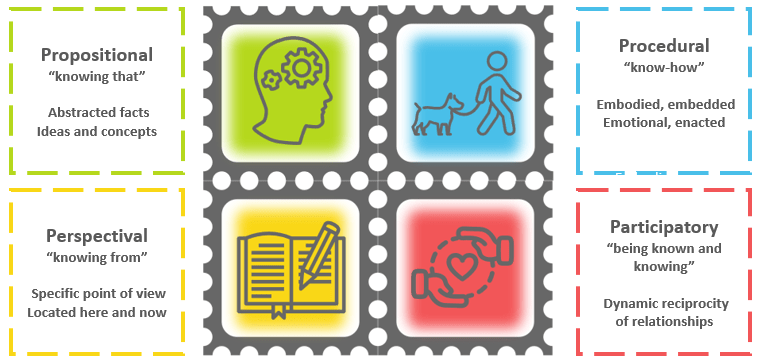
Philosopher and cognitive scientist John Vervaeke offers a framework that helps us hold the complexity of human experience with integrity through the dimension of four kinds of knowing:  PropositionalProceduralPerspectival, and Participatory. These categories explore the length, breadth and depth through the unfolding experience of time.

Being aware of these dimensions allows us to subtly tease apart the laminated layers of experience, which are much more than just academic categories—they help us attend to the whole person.


1. Propositional knowing: held in the head

This is the realm of facts, beliefs, and ideas—the “head” knowledge. It’s where theology and philosophy live, where doctrines and theories are debated. But propositional knowing has its limits. It is a distillation of lengthy deliberations stripped of their particularity—the map, not the terrain. Propositions orient us and set our direction, but they lack specificity. They rarely answer the individual cries of “Why did this happen to me?” or “Where is God in this?”

When someone is in crisis, their beliefs may no longer make sense. They may feel betrayed by the very truths they once held dear. This is the terrain of cognitive dissonance, where what we believe and what we experience no longer align.

In these moments, explanations, shallow solutions or fast resolutions fall short. We work with the “is,” not the “ought.” We honour the real, not the ideal. We are listening for the deeper questions beneath the surface, knowing that some truths can only be lived, not solved.


2. Procedural knowing: held in the body

Procedural knowing is embodied. It’s the knowledge of the body, of habits, of rituals, of the unspoken. It may take the form of absent-mindedly pouring a cup of tea, or the pattern of folded hands to receive communion, the rhythmic pounding of the pavement on a run or the instinctual understanding that accompanies bike riding. Or, it might take the form of intuition or the sensation of having hit the car’s brakes before you even saw the child running out between parked cars.

This type of understanding is particularly crucial in trauma-informed care. The body remembers what the mind cannot articulate. Emotions, sensations, and gestures often speak louder than words.

Here, spiritual care becomes accompaniment. We meet people in their rituals, their silence, and their tears. We use poetry, music, liturgy, and touch (when appropriate) to communicate love and safety. We recognise that even those who cannot articulate their faith may still live deeply spiritual lives.


3. Perspectival knowing: held in the story

Perspectival knowing is about context. It’s about how people see the world, how they interpret their experiences, and how their stories shape their identity.

This is where narrative becomes a powerful vehicle. By helping people see their stories in a different light, we invite them to see their lives through new lenses.

We draw on metaphors, parables, and even paradoxes to help people find meaning. We honour their “horizons of significance,” as philosopher Charles Taylor puts it, and gently expand them. We don’t impose our perspective—we help them discover their own.


4. Participatory knowing: held in the heart

Finally, participatory knowing is relational. It’s the “I-Thou” space described by Martin Buber, where we meet each other not as problems to be solved, but as sacred beings to be encountered.

This is the deepest kind of knowing. It’s not about information—it’s about transformation. It’s about being with someone in their suffering, not above it. It’s about mutual presence, shared vulnerability, and the sacred dance of trust.

In participatory knowing, we don’t just offer care—we become part of the care. We pray together, we cry together, we sit in silence together. We become companions on the journey, not just guides.


Why it matters

In spiritual care, no single kind of knowing is enough. Wisdom engages all dimensions of knowing. We need the clarity of the head, the habits and intuitions of the body, the insight of the story, and the intimacy of the heart.

This is especially true in spiritual care, where the boundaries between life and death, hope and despair, justice and injustice, and faith and doubt become porous. Here, the spiritual carer must be fluent in all four languages, able to move gently between them as the moment requires.


The content of the post is drawn from pages 16-18 of a journal article I wrote in 2022. The rough draft was created from the article with the help of an AI assistant, and then I refined it personally. The 4P infographic draws on summarised material from the article by Vervaeke and Ferraro.

Confusing a reflection with its reality

Spiritual and religious practices are not coping mechanisms although they may help a person cope.

Research into the relationship between religiosity, spirituality, and health is a growing field that has gained significant attention in academic literature. Many studies now show that people who describe themselves as religious and/or spiritual also demonstrate a positive association with attributes such as a sense of meaning and purpose, peacefulness, psychological well-being, and social connections.

However, concerns have been raised that some measures of religiosity and spirituality (R/S) may be contaminated with indicators of mental health in the research questions, leading to tautological associations. One way of envisioning this problem is to mistake a reflection for the reality it represents and then be surprised by the coincidence that the reflection and the reality resemble each other so closely.

Some confusion arises from the difference between practice and research. 1) Spiritual and religious care practices concerning the whole person include physical, mental, and social well-being. Care is provided through concern that connects through compassionate presence and conversation. In contrast to spiritual and religious care, 2) research into the specific functions and modalities of religiosity and spirituality (R/S) focuses on the unique contribution of religious and spiritual practices, perspectives, and attitudes informed by religious, wisdom, philosophical, or spiritual traditions.

This problem is explained in a recent article by Harold Koenig (Professor of Psychiatry and Behavioral Sciences at Duke University School of Medicine) and Lindsay Carey (Associate Professor (Adjunct) with the Palliative Care Unit, School of Psychology and Public Health, in the School of Health, Science and Engineering at La Trobe University).

Koenig and Carey note that some religiosity and spirituality research scales do not clearly distinguish between different R/S factors and their connections, effects, and causes on health outcomes, mainly mental health, meaning and purpose, connections with others, peace, and existential well-being. Their article discusses concerns about R/S measurement scales, identifies examples of contaminated measures, and recommends uncontaminated measures for future studies.

It is necessary to separate the extrinsic spiritual and religious care provided to a person by a spiritual carer from the intrinsic religiosity and spirituality held by the person themselves.

It is necessary to separate the extrinsic spiritual and religious care provided to a person by a spiritual carer from the intrinsic religiosity and spirituality held by the person themselves. Once separated, it is then possible to evaluate the extent to which a person is enlivened and sustained by religious and spiritual practices, perspectives, beliefs, rituals and communities. Such religiosity or spirituality is more than a community belief or set of doctrines; it is held personally and is present already, or emerging, becoming an integral part of their person, functioning more like a spiritual endoskeleton than an exoskeleton.

A key feature of spiritual and religious practices is that they are not coping mechanisms although they may help a person cope. Religious and spiritual outlooks provide insights and evolving perspectives that engage topics as wide-ranging as life and death, suffering and injustice, mortality and divinity, good and evil, the sublime and the beautiful, guilt and forgiveness, concreteness and fleetingness, certainty and mystery, or finitude and infinity. Transformations happen through processes of prayer, contemplation, meditation, a sense of the mysterious or miraculous, gift or grace, a leap of faith or a journey into the unknown, or a willingness to take the road less travelled.

A religious or spiritual outlook may not necessarily change a person’s material circumstances. Still, it may provide an alternative perspective on events, which in turn reframes issues of meaning and purpose. Examples of religious or spiritual perspectives can be seen in the writings of Holocaust survivor Viktor Frankl’s Man Search for Meaning, a translation of a book written in German, with the original title, Nevertheless, Say “Yes” to Life: A Psychologist Experiences the Concentration Camp. Paul Kalanithi, a young neurosurgeon dying of a brain tumour, pondered the question of what makes a life worth living and wrote When Breath Becomes Air. Or the books of Kate Bowler, a sufferer and survivor of stage IV cancer, Everything Happens for a Reason: And Other Lies I’ve Loved or No Cure for Being Human: (and Other Truths I Need to Hear).

Roger Gottlieb wrote that we often think of spirituality as soothing music, peaceful countryside settings, or compliant love, however, spiritual teachings are quite radical. Jesuit theologian Walter Burghardt once described contemplation as taking a “long, loving look at the real.” Religious and spiritual practitioners practice long, loving looks at the ‘real’ holding another in a loving gaze, not a passing glance, and together, they explore the reality, caught only in shimmering and fragmentary reflections.


First Impressions and Spiritual Care

“You need to engage and connect with consumers quickly. If your first impression rubs people the wrong way, odds are slim you will have the chance to change their minds because it takes 20 encounters to repair a bad first impression.”

If you are a spiritual care practitioner who visits people on an incidental basis in contrast to a request for a visit or a scheduled appointment, the following quote from a design website might give us pause for thought. Still, I suspect you already intuitively know this if this is your ministry!

It only takes 3 seconds to form a first impression.

“You need to engage and connect with consumers quickly. If your first impression rubs people the wrong way, odds are slim you will have the chance to change their minds because it takes 20 encounters to repair a bad first impression.”

Now, the three seconds has been disputed, and others claim that it’s 7 seconds, but seminal research conducted at Princeton University (Willis and Todorov, 2006, 592 -598.) is more sobering; their findings concluded that a first impression is formed within a tenth of a second. And in the time following, people generally become more confirmed and differentiated in their first impression. The Princeton study measured students’ responses at .1 of a second, .5 of a second and one-second exposures to photographic images of people. Five experiments were conducted, each focusing on a different judgment from facial appearance: attractiveness, likeability, competence, trustworthiness, and aggressiveness. In contrast to attractiveness and liking, trustworthiness, competence, and aggressiveness are specific traits with clear behavioural manifestations. These traits are also important for both social and economic interactions.

Of particular interest in spiritual care, trustworthiness is critical for our consideration.    

Willis and Todorov expected the highest correlation to be made with and without time restraint regarding attractiveness; however, trustworthiness judgments showed the highest correlation. The researchers concluded that this was not surprising as psychologists have linked trustworthiness to human survival, and the detection of trustworthiness may be a spontaneous, automatic process linked to activity in the amygdala, a subcortical brain structure implicated in detecting potentially dangerous stimuli. Conversely, work with patients with bilateral amygdala damage shows an impaired ability to discriminate between trustworthy and untrustworthy faces.

Yet, as spiritual care practitioners, this should not surprise us, as both psychologist, Carl Rogers and medical doctor, Paul Tournier demonstrated in the 1930s and 40s that in client-centred, and holistic patient care, a non-anxious presence that exhibited congruence, authenticity and a non-judgemental manner allowed a person to speak what was on their mind.

More recent work on Trauma-informed care has confirmed the work of Rogers and Tournier, and demonstrated that it is not enough to be a trustworthy and safe person; it is necessary to be able to engender a sense of trustworthiness and safety in the other person.

More recent work on Trauma-informed care has confirmed the work of Rogers and Tournier, and demonstrated that it is not enough to be a trustworthy and safe person; it is necessary to be able to engender a sense of trustworthiness and safety in the other person. In reading this, we might ask, what must I do? Who can possibly make a good impression in a .1 of a second? The answer, of course, is there is nothing we can do within a .1 of a second, but the good news is that if we change the question to, who must I be, then it is possible to be well prepared before the encounter and in the encounter to be present as a safe and trustworthy person who is settled in their own faith, safe with others and effective in their care.

How might we prepare for such a spiritual care encounter? Essentials include being well-centred and grounded in your own faith or beliefs and for your faith to be congruent and well-differentiated from the fleeting opinions of others. Secondly, it is important to be well-trained in safe and empowering skills. Third, a good grasp of working non-judgementally in the dynamic space between people’s belief systems and the changes they are experiencing.

On another layer, personal presentation matters – are you relaxed and comfortable in your own skin? Have you left your worries and concerns behind? Clothes and cosmetics matter. It has been observed that spiritual care practitioners in hospitals often wear cardigans or jumpers rather than coats or suit jackets and wear minimal makeup so the face can be seen (which, admittedly, has been much more difficult with surgical masks). The initial presentation of the spiritual care provider needs to promise hospitality and the possibility of being listened to.

It might be becoming apparent that this is not a ministry for everyone who longs to serve. There are unique circumstances around visiting people who are not expecting someone to visit concerning their spiritual care and decide if they will accept the offer within seconds. Not everyone is fleet of foot and thought, lots of people need more time to warm up to people, to get to know them, and use second chances to build deeper relationships, but in the fast-paced, impersonal world of hospitals, there are few second chances if we are unable to secure a connection with seconds.

Nevertheless, it is not that there are no second chances, it is possible to come back from a less-than-impressive first impression, but as mentioned above, other research has shown it may take twenty more instances to repair the poor first impression.


Soul care—scaffolding, not mortar

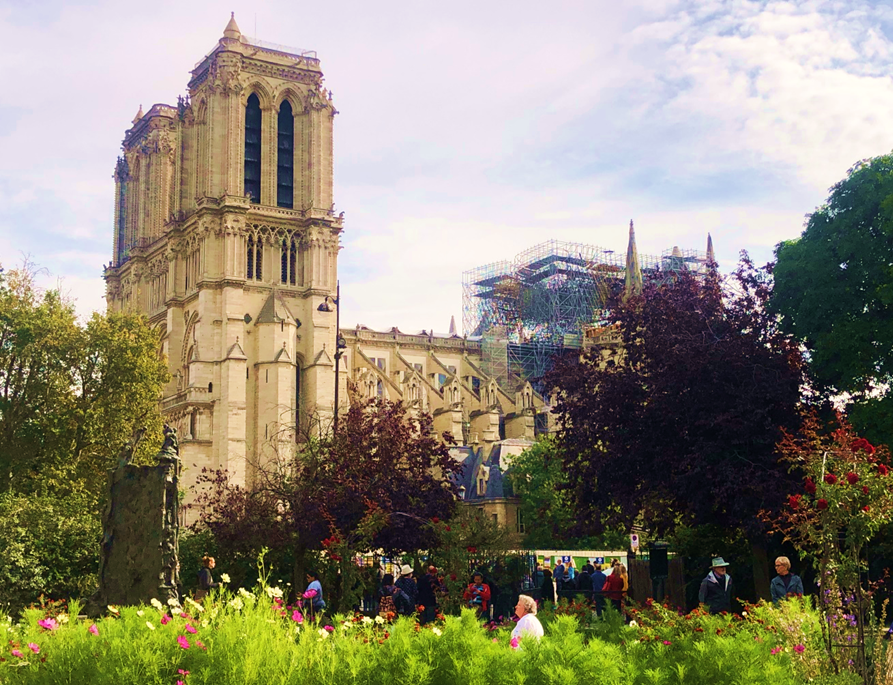
Soul carers, not unlike the scaffold around Notre Dame, provide external support where and while it is specifically needed and then at the appropriate time is dismantled. Scaffolding provides support during times of repair and change. Soul care accompanies, supports and holds people (while maintaining critical distance) through their process of sense-making and finding their way into their new reality. Such scaffolding is both an art and a skill.

I wish to suggest that soul care, either specifically religious care or more general spiritual care, is a supportive scaffold accompanying a person through a difficult situation rather than intervening with a mortar mix that becomes integrated into the structure.

Photo credit: Cathedral of Notre Dame, Paris, by Melinda Young Stuart

Soul carers have been hampered by the inability to give a clear account of the skills they bring to their role, and it has become tempting to turn to clinical interventionist language. There are, however, inherent dangers in speaking of intervention when ministering to people in complex and multilayered constructs where many factors are obscured from us, and we have no way of predicting the myriad possibilities of future unfoldings. While it is true that the term intervention is used in the sense of becoming involved in a difficult situation and providing facilitation, empowerment, resources, support or mediation, it is equally true that the semantic range of ‘intervention’ also includes instruction, direction and involvement right through to intrusion, imposition and interference.

An attractive aspect of the term “intervention” may be that it captures something of the disruptive nature of certain events in a person’s life; yet, on closer inspection, the disruptive aspect more closely corresponds with the actual events rather than granting permission for interuptive actions of care for the person. It is this care that I think is more properly conceived as a scaffold, providing a framework and support around a person while they make the necessary adjustment to a new reality or realisation.

…good scaffolding must be from a trustworthy source, safe, and consist of high-quality and well-integrated components that can bear considerably more weight than is required. Scaffolding is also diagonally braced to provide strength and stability, designed to resist both tension and compression forces.

In the construction industry, good scaffolding must be from a trustworthy source, be safe, and consist of high-quality, well-integrated components that can bear considerably more weight than is required. Scaffolding is also diagonally braced to provide strength and stability and is designed to resist both tension and compression forces. This provides an apt metaphor for soul care. Soul care must be trustworthy, safe, fit for purpose, and internally well-integrated, maintaining separation while being intimately connected and able to withstand pressure and tension.

Soul carers, not unlike the scaffold around Notre Dame, provide external support where and while it is specifically needed and then at the appropriate time is dismantled. Scaffolding provides support during times of repair and change. Soul care accompanies, supports and holds people (while maintaining critical distance) through their process of sense-making and finding their way into their new reality. Such scaffolding is both an art and a skill.

Scaffolding creates a framework that is robust enough to hold space for another when they are struggling to bear the weight of their own burdens.  This is not to imply that a person’s healing comes from within or only from their own resources, any more than a building builds or repairs itself, but scaffolding provides support, safety, and space while repair is undertaken. Nor do I mean that to scaffold is not to speak, but rather, it is a type of speech that helps the other find their lost words and voice. The scaffolded space is a transformative space where reassessment, realignment, restorative work, and replacement of elements can happen. Scaffolding, while holding space and providing structure and security, remains separate, allowing for restorative work to happen and all the emergent possibilities that arise from the scaffolded time.

As the soul carer quietly and safely externally scaffolds, internally, they are drawing on all their training – their theological and philosophical frameworks, reflective practices, deep listening skills, trauma-informed care, cross-cultural and diversity competencies, mental health first aid and patterns of grief and loss. As they scaffold, they bear witness to the circumstances of the other and bear witness to the wisdom and skill entrusted to them, and begin to locate the focus of the patient’s concerns and listen for the soundings of spiritual distress.

When someone is comfortable, they are more likely to open up about themselves and their beliefs. This type of dynamic two-way communication is predicated on the listener being a good listener and valuing the other person and their beliefs, which in turn leaves the other person feeling like they have been understood. Soul carers can be trusted to work safely with others’ exploration of meaning, belonging, and purpose, or even their faith, hope, and love, without becoming mortar by inserting themselves into the other’s life. The soul carer scaffolds through listening and reflective questioning, creating space for deeper narrative integration on both the horizontal and vertical domains.

The metaphorical phrase ‘Scaffolding, not mortar’ has been borrowed from a daily lectionary reflection by theologian, Alistair Roberts
Photo credit: Cathedral of Notre Dame, Paris, by Melinda Young Stuart (edited slightly)
https://www.flickr.com/photos/melystu/49128335038/in/photostream/ https://creativecommons.org/licenses/by-nc-nd/2.0/

Complexity in Spiritual Care

Much has been written on the place of liminality in the chaplain’s work, and the place of mystery and presence when working with spirituality, but in focusing on these implicit aspects, little attention has been paid to that which can be understood more explicitly, and to those things which can be done to reduce some of the ambivalence and uncertainty around the role. 

Arndt Büssing describes spirituality as a complex and multi-layered construct (Büssing 2021). Each spiritual care encounter presents the chaplain with unknowns. The encounter is shaped by whatever it is that the patient or client presents and requires the chaplain to be both grounded, flexible, and creative simultaneously as they respond.

The complexity of the situations of the people requiring care is only part of the complexity of the chaplaincy role, and this may be the least ambiguous part of the role. There are two aspects to role clarity: first, the SCP’s own understanding of their role, and second, the organisation’s understanding of their role. This second point for clarification highlights the need to navigate highly complex organisational matrices with multilayered constructs of possibilities and limitations that come with the role, many of which are not within their individual control.

Fig. 1. The Cynefin Sense-Making Framework (Mark and Snowden, 2006)

Much has been written on the place of liminality in the chaplain’s work, and the place of mystery and presence when working with spirituality, but in focusing on these implicit aspects, little attention has been paid to that which can be understood more explicitly, and to those things which can be done to reduce some of the ambivalence and uncertainty around the role. 

Role clarity is essential to mitigate role confusion, conflicts of interest, power imbalances, and unclear limits and permissions and enable emergent possibilities to open. Key factors around role clarity in spiritual care include understanding the reason and purpose of the role, acknowledging levels of training and experience that define the scope of practice, and recognizing possibilities and limits. A further factor in role clarity is differentiating between broad spiritual care and more narrow and specific religious care, as well as being willing to critically assess and evaluate the spiritual care provided. To this list, we could add the ability to identify requests for complex spiritual care encounters from the many other claims made during a SCP’s time.

Most encounters begin momentarily in a confused space as we gather our initial impressions and information and decide where to go next. For this reason, I find the Cynefin sense-making framework invaluable. 

Most spiritual care encounters begin with a phone call or a referral, or when someone comes into the office or attends a worship service, we encounter them in their space: a workspace, residential home, hospital ward, exercise yard, or tea room. Initially, we are listening for the ‘edge,’ the inquiry, the unresolved dilemma, or whatever is frontmost in a person’s mind at this time. Most encounters begin momentarily in a confused space as we gather our initial impressions and information and decide where to go next. For this reason, I find the Cynefin sense-making framework invaluable (pronounced ku-nev-in). 

The Cynefin framework was developed to assist strategic and organisational decision-making (Mark and Snowden, 2006). The framework has been successfully employed in a number of other situations and used to help with medical triaging. The genius of the Cynefin framework is the key insight that different types of problems or situations presenting as such require different and non-interchangeable approaches and responses.

The four categories of the framework are clear, complicated, complex, and chaotic, each of which requires a distinct response:

  • Clear (straightforward as cause and effect are clear)—sense -> categorise -> respond;
  • Complicated (requires expertise, but cause and effect are related)—sense -> analyse -> respond;
  • Complex (co-creative, working with patterns and correlations)—probe -> sense -> respond;
  • Chaotic (first aid as there are no discernible patterns)—act -> sense -> respond. (Mark and Snowden 2006)

An example of a clear spiritual need (sense, categorise and respond) occurs when the staff or patients know what they need and simply request it, such as an inquiry regarding the use of the quiet room, a service time, or a request for a Bible, prayer beads, or something similar. If departmental procedures are in place with these everyday items or information on hand, requests are easily addressed. 

A complicated spiritual need (sense, analyze, and respond) may be a request for Holy Communion, end-of-life prayers, or rituals. After hearing the request, it is essential to understand or analyze it in order to provide an appropriate response and refer to the person with the precise expertise to conduct the service or ritual. These requests are directed to the chaplaincy or spiritual care department for them to make the necessary phone calls and set up the visit. Such requests are highly specific and can only be met by a representative of a particular faith.

The heart of spiritual care and chaplaincy lies within the complex and multilayered constructs described by Büssing and should be referred to the specialist SCP or chaplain for further assessment. The approach for complex requests is to probe, sense, and respond, leading to a conversation that often continues with “Are you able to say more about that?” or “It sounds like…” or “did I catch that correctly?” There is no clear answer or solution to these needs, as there is no simple cause-and-effect relationship between events and possible solutions because the needs are interrelated and interleaved with other people, events, histories, and possibilities. There is a need to work slowly and at slant, carefully separating layers of need from other things and being willing to refer on to others when needed.

Chaotic cases, as described in the Cynefin framework, are often emergencies, requiring multiple interventions by many interdisciplinary professionals to arrest the descent into further chaos. The response to chaotic situations is to act, sense, and respond. For example, recently, I heard a man and woman arguing in an escalating manner about their child. Although I considered talking with them, sensing that there was a spiritual need, I acted. I called security and waited for them to arrive before assessing the spiritual need or distress that needed addressing for either person. Once a chaotic situation settles, spiritual care needs will default to one of the three categories clear, complicated, or complex.

Spirituality includes a person’s wider relational network; because of this, it includes caregivers and family, who may be experiencing even greater complicated, complex, and chaotic needs. Furthermore, as each person experiences events from differing perspectives and timelines, it is possible across a relational network to have clear, complicated, complex, and chaotic needs presenting simultaneously, in which case it is important for the SCP or chaplain to notice whose needs are coming into focus and being addressed, and whose ongoing needs recede into the distance and remain unaddressed.

The Cynefin sense-making framework helps SCPs and chaplains reduce some of the ambiguity and confusion around their role in order to conserve capacity for the truly complex spiritual care they provide. If this is possible – then it is surely worth considering.

The Power of Bearing Witness

Bearing witness is the capacity to speak of what is seen and known related to this situation and to weave these strands of stories together, catching deeper meanings and forging new links.

Being present with people and bearing witness to the needs of their soul is a profound privilege. We have the honour of providing spiritual care to anyone who needs or desires a space to explore their religious and spiritual needs.

I greeted Isabel; even lying down she seemed a a tall upright woman. She was in her late eighties and spoke in short staccato sentences delivered in a soft raspy voice. Her wiry hair was unkempt and the paper thin skin on her arms showed signs of years of life in the sun.  Isabel was waiting for a blood result to come back and we chatted for a short time about life on the farm.

Isabel seemed to be tiring and thanked me for coming. As I was placing the chair back against the wall, I was caught by surprise as she spoke again, “You know, I’m not afraid of dying, but I feel so sad I won’t see my great-grandchildren grow up…. so full of life; I wonder what they will do.” Isabel drew a breath, “Will they follow the way?”  

I was unsure if Isabel was really speaking to me, or was I hearing a breath prayer? I asked Isabel if there was anything I could do for her. She said at home, her husband usually read Bible to her because her eyesight was poor, but he had just handed in his driver’s licence, and now it was hard for him to come to the hospital. I offered to read for her if she would like, and she motioned toward a worn black leather Bible with a booklet of daily Bible readings tucked into it on the bedside table. She said, just read the page where the notes up to.

The notes directed me to Psalm 42,  

8By day the Lord directs his love,
    at night his song is with me—
    A prayer to the God of my life.

I say to God my Rock,
    “Why have you forgotten me?
Why must I go about mourning,
    oppressed by the enemy?”
10 My bones suffer mortal agony
    as my foes taunt me,
saying to me all day long,
    “Where is your God?”

11 Why, my soul, are you downcast?
    Why so disturbed within me?
Put your hope in God,
    for I will yet praise him,
    my Savior and my God. (NIVUK)

We prayed for her grandchildren. Isabel wept, wiped a tear from her eye, smiled and thanked me.

Bearing witness works with the real, not the ideal, with fragments and shards, frailty and fallenness

Bearing witness is a deeply embodied and active ministry; it comes from the word marturein in Greek, from which also comes our word martyr matureo. Witness is experiential, embodied and ensouled. It concerns what we have seen with our eyes, and what we know in our heart, it directs our conscience, and shapes our character. Bearing witness is an activity of remembering and anticipating, of word and deed, giving and receiving. Bearing witness is the capacity to speak of what is seen and known of this situation and to weave these strands of stories together, with other older stories, catching deeper meanings – forging newer links. Jesus becomes tangibly visible in the room, his Spirit groans and prayer is given voice. He promised that when two or three gather in his name he is present – eternity enters time. Bearing witness works with the real, not the ideal, with fragments, shards, and the frailty and fallenness of life yet it draws evermore forward into deeper reality ushering in new dawns evens as night falls.

Bearing witness responds, rather than directs, opens rather than closes, flows rather than programs, attunes rather than affects. There is an unpremeditated aspect of bearing witness that is always somewhat serendipitous.

Photo by Jon Eric Marababol on Unsplash

Creating a culture of spiritual care

A multidisciplinary team of medical and spiritual care researchers recently made three significant findings: (1) spiritual care needs to be incorporated into care for patients with serious illness; (2) spiritual care education needs to be integrated into the training of interdisciplinary teams caring for persons with serious illness; and (3) include specialty spiritual care practitioners in the care of patients with serious illness.

A general manager asked one of my chaplaincy colleagues about her vision for integrating pastoral care into their facility.  This inquiry is such a brilliant, open-ended question that opens up so many avenues.  Where might we begin?

In healthcare, it has been a long-standing tradition for the chaplain to take care of the spiritual and eternal needs of the patient’s soul while the doctor took care of the patient’s physical needs.  During the twentieth century, there was a complete separation of the roles of faith and medicine.   Physician Paul Tournier challenged this view of separation.  In his private practice, he forged a new type of medicine, which he called “the medicine of the person. ” The medicine of the person integrated both physical and spiritual health.  In the 1960s, palliative care was developed, and with it came a new idea of spiritual care or general pastoral care in medicine. This was an alternative to the traditional model of religious care, which was based solely on a person’s faith and denomination.

Tournier’s influence made its way into the medical systems through various avenues, of which palliative care was at the forefront.  Cicely Saunders, the doctor who founded the modern concept of palliative care, talked about the idea of “total pain” and the need to address a patient’s medical, psychological, social, and spiritual needs all at once.  Saunders herself was an evangelical Christian who recognised that everyone has a spiritual nature – each patient and every member of staff.  In her hospital, a chapel for Christian worship, was available for quite reflection for all, and spiritual care of a general nature was the role of every staff member and no patient should have their spiritual needs go unmet.

Fig 1. Generalist-Specialist x Broad-Narrow Spiritual Care Matrix

Saunders’ biopsychosocial-spiritual framework gave rise to the current generalist–specialist spiritual care model.  In this model, all staff are responsible for spiritual care at a general level which is expressed through holistic care, and concern for aspects of the patient’s well-being including their spiritual/religious dimension which is usually expressed through compassionate presence.  Compassionate presence is the ability of all staff members to be deeply present to the patients in their whole being with a concern about their whole life –­ family, faith, losses, griefs, hopes and cares.

In Saunders’ model spiritual care is integrated into the facility.  All staff receive training in primary spiritual care which includes training in understanding what might be necessary to the patients beyond their medical care, being a safe self-aware person, who is comfortable in their own skin and religious and spiritual beliefs who is able to create space for other to speak about the things pressing most closely on their heart.  Such a system might also include volunteers and pastoral carers who have been trained in general spiritual care and who have time to visit with patients hearing their perspectives.

In the generalist–specialist model, there are also specialist spiritual care practitioners who may be trained narrowly within one religious tradition and others who have been trained more broadly in aspects of personal formation, within which there are levels of expertise: foundational, advanced and expert.  The spiritual care practitioners who work to help scaffold people through times of change and spiritual adjustment have trained to a professional level.  Various training pathways exist in fields of spiritual direction, pastoral counselling, clinical pastoral education, and philosophical therapies that work with people’s reality.  These spiritual care practitioners provide spiritual care to a wide range of patients across the service, including patients who might describe themselves as spiritual but not religious and others who consider themselves to be neither religious nor spiritual.  In this system, there are also specific religious visitors who visit people of their own denomination or religion, who visit and pray, conduct rituals, offer blessings, or read sacred texts.  The distinctions here, are often described as ward-based visiting and faith-based visiting.  A comprehensive spiritual care service provides both.

The research team stressed the importance of adequate spiritual care training for all staff (including any volunteers and pastoral carers in a facility who have contact with patients with serious and life-limiting illnesses), as well as referral channels and access to specialist-level trained religious and spiritual care practitioners.

A multidisciplinary team of medical and spiritual care researchers recently conducted a meta-analysis scanning thousands of academic papers that focused on spirituality and medicine.  They then focused in on 371 papers concerning spirituality in serious illness and health and identified implications for patient care and health outcomes.  The team made three significant findings: (1) spiritual care needs to be incorporated into care for patients with serious illness; (2) spiritual care education needs to be integrated into the training of interdisciplinary teams caring for persons with serious illness; and (3) include speciality spiritual care practitioners in the care of patients with serious illness.

The research team stressed the importance of adequate spiritual care training for all staff (including any volunteers and pastoral carers in a facility who have contact with patients with serious and life-limiting illnesses), as well as referral channels and access to specialist-level trained religious and spiritual care practitioners.

In order to more fully appreciate the finding of this review, it might help to think of spiritual care in its broadest sense, as a 2×2 matrix where spiritual care is offered both at generalist and specialist levels through both broad and narrow expressions of spiritual and religious care, where all quadrants are needed to meet the ongoing spiritual needs of patients.  There is also overlap where narrow religious care often incorporates broad general spiritual care, and many specialist religious practitioners are also certified in broad specialist spiritual care. It is also possible that people hold different positions in the matrix depending on the role a carer is performing at a particular time for example, a nurse who may also be trained in a specific religious tradition who might also provided narrow-generalist care if needed.  

A vital function of an integrated matrix for a health facility would be to describe the scope of spiritual practice for each section, which clearly outlines the skills and capabilities, as well as the limitations of practice for each quadrant of the matrix.

Fig 1. Generalist-Specialist x Broad-Narrow Spiritual Care Matrix is drawn from my research in The Nature of Religious and Spiritual Needs in Palliative Care Patients, Carers, and Families and How They Can Be Addressed from a Specialist Spiritual Care Perspective

Relating Soul to Spirit

Staff who feel comfortable with their own spirituality have been shown to be most at ease talking with patients about what really matters to them in the areas of religion or spirituality.

Have you ever wondered how the language of soul care and spiritual care relate to each other? The soul is a concept that arises from Scripture. Spiritual care and spirituality have been described as travelling terms, around which over the last fifty years has grown a consensus definition related to a person’s meaning, beliefs, purpose, belonging and rituals. As is common in most chaplaincies, there is a need to be bi-lingual, across different domains as has its own lexicon of terms and areas of interest. However, while overlapping, as shown in the following figure, the terms soul and spirit are not synonymous.

Figure 1. The relationship between the soul and the Biopsychosocial-spiritual model

From a Biblical perspective, all people not only have souls but are souls, each being a mysterious combination of dust and breath first described in the book of Genesis (Gen 2:7). Perhaps the most confusing aspect of the soul is around the word breath or spirit. The confusion has arisen because breath (or spirit or wind) which is used in a general or universal sense as above, is a ‘small s‘ spirit as distinct from the more specific ‘capital S‘ Spirit which refers to the redemptive work of the person work and indwelling of the Holy Spirit, which relates quite specifically to Christian faith.   

In Scripture, the term soul is not a particularly religious word but rather speaks to the unity or totality of the human person, as in the way the marriage ceremony speaks of “all that I am and all that I have”. At its simplest, the soul is dust of the earth animated by the inspiration (or inbreathing) of the breath of God and reminds us that people, like all of creation, are enlivened, animated and sustained by the Creator God. However, it is only human souls, or beings, that are said to bear the image of God, which makes the all encompassing created nature of each soul even more valuable.

The biopsychosocial-spiritual model seeks to describe parts of the unity and totality that make up a person and seeks to honour the dignity of each person.

From a health perspective, working with the biopsychosocial-spiritual model, all people are said to have physical, mental, social and spiritual aspects of personhood or existence. In this regard, we can see that the biopsychosocial-spiritual model of the human person seeks to describe parts of the unity and totality that make up a person and seeks to honour the dignity of each person and tends toward to the Biblical concept of the soul.

In the medical model, the biological aspect of a person refers to their physical health; the psychological aspect refers to emotional and mental health; the social aspect refers to the larger social and cultural systems within which a person is embedded. The spiritual health refers to a person’s non-material aspects of being – including their relationships, values, beliefs, hopes and possibilities. It is this non-material aspect which corresponds most closely to the breath or animating or inspiring aspects of the soul.  

From a soul care perspective, in Christian ministry, we are expressing a holistic concern for people through radical hospitality, compassion, love and care. From a health and spiritual care perspective, there is particular concern for a person’s non-material needs, especially the way in which a person is making sense of their reality and the changes happening about them; this includes people’s religious and spiritual beliefs. This is crucial because a patient for whom religion is important, their faith may well be providing the interpretive grid over all that is happening. For example a Christians patient may well be viewing every aspect of their physicality, psychology and social relationships through the lens of their personal beliefs and the interactive presence of indwelling of the Holy Spirit in their lives.  

From a spiritual care perspective, all staff are expected to provide general spiritual care as they care holistically for their patients. They are encouraged to provide a compassionate presence expressing concern for their health, social and emotional well-being as well as those less tangible things such as their deep beliefs, motivations and the way in which they envision their future. Staff are encouraged to identify patients who are expressing needs in any of these areas and refer on to specialists, psychologists, social workers or spiritual care practitioners or chaplains.

Staff who feel comfortable with their own spirituality have been shown to be those most at ease when talking with patients about what really matters to them in the areas of religion or spirituality. If the patient’s spiritual care needs are connected to a particular faith or religion, it is important to connect that patient to a chaplain who can most closely meet that person’s needs.