
One of the most helpful ways of understanding healthcare chaplaincy is through the concept of liminality.
The word comes from the Latin limen, meaning “threshold”. It describes those in-between places where people have left what they once were but have not yet become what they will be. We encounter liminality during times of transition, uncertainty, loss, change, and possibility.
Hospitals are full of these threshold spaces. Illness, recovery, dying, grief, birth, trauma, hope, and uncertainty all create moments where the familiar gives way to the unknown.
Chaplains inhabit multiple liminal zones.
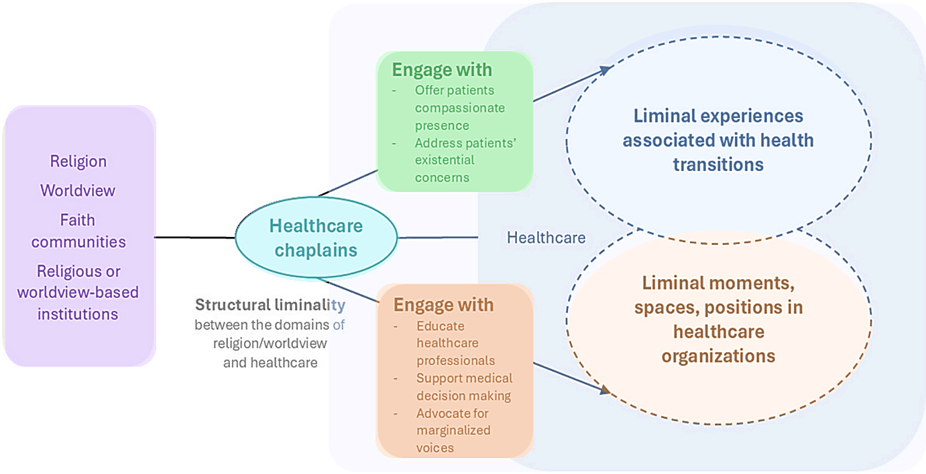
Fig. 1 The liminality model of healthcare chaplaincy.
The liminality of chaplaincy itself
Chaplaincy itself is a threshold vocation. As we work alongside healthcare teams, we also remain anchored in broader spiritual, religious, philosophical, and cultural traditions. Standing between worlds, translating, connecting, and creating space for conversation.
Clinicians primarily focus on diagnosis, treatment plans, and measurable outcomes, while chaplains attend to a different set of questions: those of meaning, personal formation, suffering, hope, purpose, belonging, and transcendence.
This can be an ambiguous space to inhabit, neither entirely inside nor outside healthcare. Yet this structural liminality is one of chaplaincy’s greatest strengths.
Because chaplains inhabit a threshold space, very often they become interpreters between competing worlds, helping patients and families navigate the complex culture of healthcare. They also help healthcare teams by communicating spiritual, existential, and relational concerns that can be easily missed.
In this way, chaplains provide a link by holding multiple perspectives at one time, facilitating conversations as deeper questions rise to the surface.
The liminality of the people we support
Chaplains meet people during significant transitions in their lives.
These transitions include unexpected diagnoses or events, the birth of a premature baby, progressive illness, the loss of independence, or the death of a loved one. Each disrupts a person’s assumptions about themselves, life, and the world around them.
Such moments suspend people between past and future. Vertigo and disorientation can set in; old certainties no longer hold, and nothing new has yet to emerge.
Liminality is rarely comfortable; it’s felt as a dark night of the soul in all its vulnerability, ambiguity, grief, and waiting, with unanswerable questions – a crucible or even a chrysalis.
While a chrysalis can appear still and fragile from the outside, it veils the deep transformation taking place within. During such times, deeper understandings, renewed relationships, unexpected strengths, and new awareness may emerge from experiences that felt only painful or uncertain.
A chaplain does not rush people through these spaces, and there are no easy answers. Through an active non-action, they hold space for others’ pain and uncertainty.
By offering attentive listening, compassionate presence, and space for reflection, chaplains help people ponder questions such as:
- What matters most now?
- How do I live with this loss?
- What gives me hope?
- How do I make sense of what is happening?
- Who am I becoming through this experience?
Threads of meaning can emerge even as one lives through crisis or even chaos.
The liminality of the systems we work within
Liminality is not limited to the personal; it can be communal or organisational.
A hospital constantly juggles competing priorities: efficiency and compassion, policies and personhood, technology and humanity, evidence and meaning. They continually adapt to new challenges, changing expectations, and emerging realities that raise existential questions about spirituality, values, ethics, culture, and human flourishing, all while balancing competing demands.
Chaplains move between patients, families, clinical teams, community groups, executives, and healthcare systems, occupying a unique vantage point, noticing tensions and synergies between disparate departments or disciplines.
In this way, chaplains can meaningfully contribute to staff support, ethics consultation, reflective practice programs, memorial services, multidisciplinary discussions, and organisational conversations about wellbeing and culture, helping create organisational spaces where reflection and compassion remain part of healthcare’s ongoing conversation.
A practice of liminality
The language of liminality offers a helpful interpretive grid to evaluate chaplaincy.
Chaplaincy is better defined as a way of being rather than a set of tasks. It is a way of attending to people and accompanying people through their liminal zones. Noticing not only what is happening to them but also who they are becoming through it.
Liminal spaces are uncomfortable because they are uncertain and unfinished. Yet, paradoxically, they can also be places that foster growth, creativity, wisdom, and transformation.
In a fast-paced world eager for quick answers and clear resolutions, chaplains offer something different: a steady presence at the threshold, helping people, communities, and organisations find meaning and hope amid change.
Healthcare chaplains inhabit liminal spaces, accompany people through their own transitions, and help healthcare organisations remain attentive to questions of meaning and human flourishing.
A distinctive contribution of chaplaincy is its ability to remain in these liminal spaces, supporting others as they navigate their liminal zones with wisdom, compassion, and hope.
Based on insights from “A Foundation for Today’s Healthcare Chaplaincy in Western Societies: The Liminality Model” by Schuhmann, Varner-Perez, Lasair, Bradford, Peng-Keller, Nuzum, and Tuffnell.

